
Lift Controller Replacement in Hyderabad | VVVF Panel Upgrade & ARD
Table of Contents
Lift Controller Replacement in Hyderabad | VVVF Panel Upgrade & ARD
Across the commercial and high-density residential developments of Hyderabad—from IT corridors in HITEC City, Gachibowli, and Financial District to residential hubs in Banjara Hills, Jubilee Hills, Kondapur, Miyapur, Kukatpally, and Uppal—vertical transportation systems rely on the control panel to orchestrate passenger traffic. The lift controller serves as the central brain of the elevator system, processing landing calls, cabin commands, door interlock safety loops, motor torque curves, and emergency rescue sequencing.
Legacy elevator infrastructure across Telangana often runs on outdated relay-logic boards or obsolete 8-bit microprocessors. These systems frequently experience contactor pitting, erratic floor leveling, high energy consumption, and thermal lockouts caused by Hyderabad’s summer temperatures exceeding $45^\circ\text{C}$. Rather than executing a high-cost total mechanical replacement, building managers and Residents’ Welfare Associations (RWAs) can modernize performance via specialized lift controller replacement in Hyderabad. Upgrading to integrated Variable Voltage Variable Frequency (VVVF) microprocessor controllers restores ride comfort, cuts power bills by up to $40\%$, and ensures full compliance with statutory safety mandates.


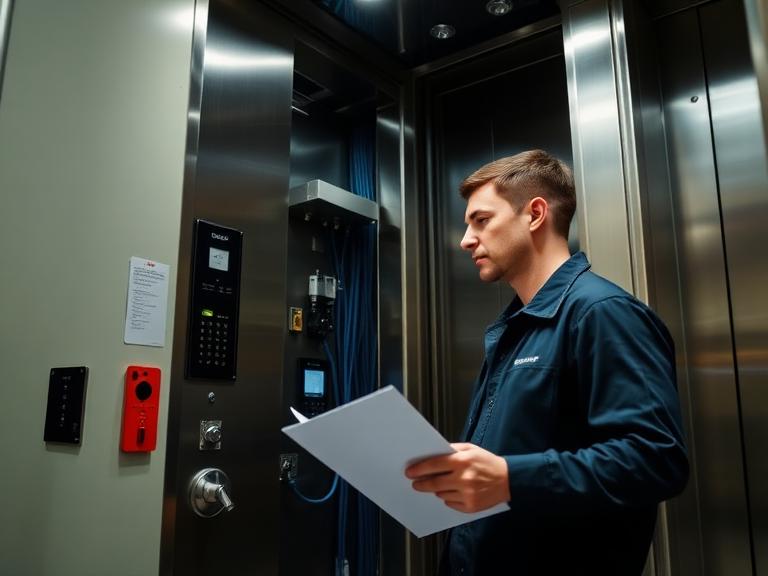
                [ Legacy Relay / Faulty Controller Breakdown ]
                                       │
                  (In-Situ Control Audit & Traffic Profiling)
                                       ▼
             [ Complete Control System Modernization Decision ]
                                       │
       ┌───────────────────────────────┴───────────────────────────────┐
       ▼                                                               ▼
┌─────────────────────────────────┐             ┌─────────────────────────────────┐
│ Control Architecture Upgrades   │             │ Safety & Signaling Integration  │
├─────────────────────────────────┤             ├─────────────────────────────────┤
│ • 32-Bit Microprocessor Board   │             │ • CAN-Bus Serial Communication  │
│ • Integrated VVVF Inverter      │             │ • Dual-Door Interlock Safety    │
│ • ARD Battery Management Unit   │             │ • Absolute Shaft Position Encoder│
│ • Regenerative Energy Unit (Opt)│             │ • Fireman's / EMS Interface     │
└─────────────────────────────────┘             └─────────────────────────────────┘
       │                                                               │
       └───────────────────────────────┬───────────────────────────────┘
                                       ▼
            [ Parameter Tuning, Ride Profiling & CEIG Clearance ]
Technical Specifications: Legacy vs. Modern Controller Architectures
Transitioning from electromechanical relay logic or discrete drive setups to an integrated 32-bit microprocessor VVVF controller changes how the elevator processes energy, diagnostics, and safety loops.
| System Parameter | Legacy Relay / Discrete Logic Controller | Modern Integrated 32-Bit VVVF Controller | Advanced PMSM Serial Control System |
| Processor Architecture | Hardwired relays / 8-bit discrete microcontrollers | 32-bit ARM Cortex microprocessor with DSP motor control | Dual-CPU 32-bit redundant processor with real-time OS |
| Drive Technology | Direct-on-Line (DOL) / AC-2 two-speed contactor switching | Integrated VVVF inverter (PWM control) | Vector-controlled PMSM gearless drive module |
| Wiring Architecture | Parallel travel cable (50–100+ discrete copper wires) | 4-wire CAN-bus serial communication protocol | High-speed RS-485 / CAN-bus optical isolated serial link |
| Leveling Accuracy | $\pm 15\text{ mm}$ to $\pm 25\text{ mm}$ (drift prone with load changes) | $\pm 2\text{ mm}$ (independent of load variations) | $\pm 1\text{ mm}$ via absolute magnetic shaft encoder |
| Energy Efficiency | High power consumption; surge currents up to $4\times$ nominal | $35\text{–}40\%$ energy reduction via smooth acceleration | Up to $55\%$ savings with optional regenerative drive |
| Fault Diagnostics | Manual multimeter trace; no historical fault logging | Onboard LED display & 100-event fault log memory | IoT cloud telemetry, real-time app diagnostics & remote monitoring |
| Safety Loop Standard | Basic hardwired door & limit switches | Dual-channel monitored hardware safety circuit | EN 81-20 / IS 14665 SIL-3 certified electronic safety board |
Regulatory Framework & Statutory Compliance in Telangana
Lift controller replacement involves major electrical modification. As a result, installations must comply with Telangana state safety laws and Bureau of Indian Standards (BIS) directives.
                   [ Building Owner / RWA Request ]
                                  │
          (Appoints Licensed Lift Modernization Agency)
                                  ▼
         [ Certified Lift Controller Installation Specialist ]
                                  │
       ┌──────────────────────────┴──────────────────────────┐
       ▼                                                     ▼
┌──────────────────────────────────┐        ┌──────────────────────────────────┐
│ Chief Electrical Inspectorate    │        │ Indian Standards & NBC Codes     │
│ to Government (CEIG) Telangana   │        │ Compliance Framework             │
├──────────────────────────────────┤        ├──────────────────────────────────┤
│ • Lift Act Form-A Modification   │        │ • IS 14665 (Electric Lifts Code) │
│ • ARD 1-Hour Backup Validation   │        │ • NBC 2016 Part 8 Section 5      │
│ • Inspection for Form-B Renewal  │        │ • IEEE 519 Harmonic Control      │
└──────────────────────────────────┘        └──────────────────────────────────┘
       │                                                     │
       └──────────────────────────┬──────────────────────────┘
                                  ▼
              [ Statutory Approval & Safe Operational License ]
1. Telangana Lifts, Escalators, and Passenger Conveyors Act
- CEIG Approval & Form-B License: Replacing a control panel alters the main drive circuitry and emergency safety loops. Modernized controllers must be submitted to the Chief Electrical Inspectorate to Government (CEIG) for safety inspection to ensure the lift retains a valid Form-B License to Run.
- Automatic Rescue Device (ARD) Mandate: Telangana elevator guidelines require every commercial and residential lift to feature an integrated ARD. The new controller must automatically monitor grid power and, upon failure, use battery power to move the car to the nearest landing floor, open the doors, and lock out movement.
2. BIS & National Building Code (NBC) Standards
- IS 14665 Compliance: The control panel must conform to safety interlock standards, overspeed governor response limits, and phase-failure monitoring.
- NBC 2016 (Fireman’s Lift Control): Buildings exceeding 15 meters in height must feature a specialized Fireman’s Control Switch integrated into the main controller panel. When activated, the controller overrides hall calls, returns the cabin immediately to the ground floor, and yields sole control to emergency responders.
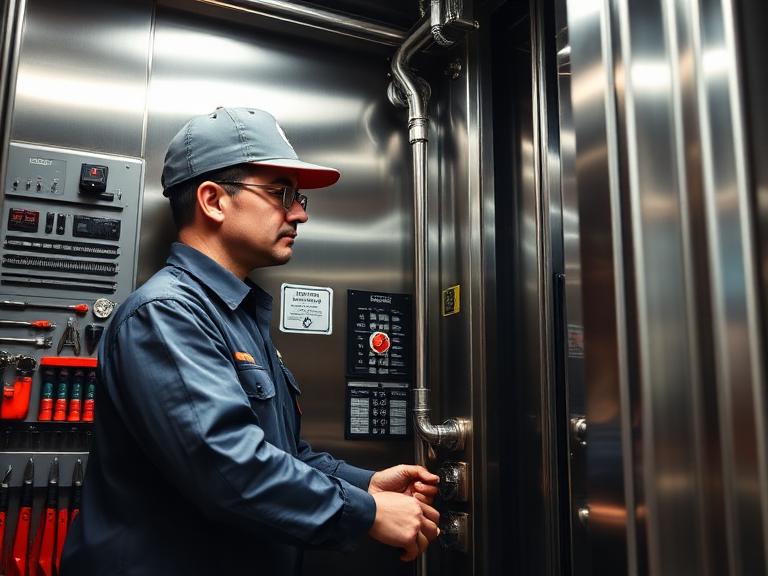
Step-by-Step Technical Controller Replacement Process
1.Phase 1: Pre-Replacement Audit & Control Mapping:Traffic Audit & System Interface Mapping.
- Audit existing elevator infrastructure, including traction motor power ratings, brake coil voltages, door operator signals, landing calls, and shaft limit switches.
- Inspect existing traveling cables, shaft wiring harnesses, and floor sensing switches for thermal wear or degradation.
- Design a custom cabinet interface diagram matching the site’s power configuration ($415\text{V AC 3-Phase, 50 Hz}$).
2.Phase 2: Power Isolation & Old Panel De-Commissioning:LOTO Implementation & Safe Extraction.
- Apply Lock-Out/Tag-Out (LOTO) protocols at the main incoming electrical distribution panel in the machine room.
- Lock the lift car frame securely using heavy-duty guide rail clamps at the top landing floor.
- Disconnect and label all incoming line phases, motor leads, brake wiring, door operator cables, and safety circuit lines. Unbolt and remove the obsolete control cabinet.
3.Phase 3: Controller Cabinet Installation & Rewiring:Cabinet Mounting & Serial Bus Interfacing.
- Mount the new IP54-rated micro-processor controller cabinet on anti-vibration rubber dampers in the machine room.
- Connect main 3-phase power lines through an isolation breaker equipped with surge protection devices (SPD).
- Install the new flexible traveling cable and establish CAN-bus serial communication nodes inside the car operating panel (COP) and hall call buttons (LOP).
4.Phase 4: Shaft Positioning & Drive Parameterization:Shaft Encoder Mounting & Parameter Configuration.
- Install magnetic shaft strips or a rotary encoder setup to enable millimeter-accurate absolute positioning tracking.
- Program the integrated VVVF drive parameters, adjusting current loops, acceleration/deceleration S-curves, inspection speed, and door timing profiles.
- Calibrate the ARD system battery bank to confirm proper automatic rescue operations during simulated power cuts.
5.Phase 5: Field Testing, Tuning & Final Inspection:Safety Audits, Ride Tuning & CEIG Handover.
- Perform full physical safety checks: verify terminal limit switches, emergency stop buttons, door photo-curtains, governor trip switches, and phase-reversal relays.
- Conduct dynamic load testing at $25\%$, $50\%$, $100\%$, and $125\%$ capacity, verifying smooth floor leveling ($\pm 2\text{ mm}$) and low motor vibration.
- Document test results in the statutory logbook and submit paperwork to the CEIG inspectorate for Form-B certification.
Technical Troubleshooting Guide for Elevator Controllers
                 [ Elevator Controller Diagnostic Triggers ]
                                     │
    ┌────────────────────────────────┼────────────────────────────────┐
    ▼                                ▼                                ▼
┌────────────────────────┐       ┌────────────────────────┐       ┌────────────────────────┐
│ Frequent Trip & Lockout│       │ Misleveling & Jerks    │       │ Door Operation Failures│
├────────────────────────┤       ├────────────────────────┤       ├────────────────────────┤
│ • Contactor Pitting    │       │ • Open-Loop V/f Drift  │       │ • Cam Relay Bounce     │
│ • Thermal Overload     │       │ • Encoder Pulse Drop   │       │ • Serial Signal Noise  │
│ • Phase Voltage Drop   │       │ • Brake Dip Timing     │       │ • Safety Loop Fault    │
└────────────────────────┘       └────────────────────────┘       └────────────────────────┘
Common Faults & Upgraded Technical Solutions
- Frequent Thermal Lockouts During Hyderabad Summers:
- Root Cause: High ambient heat in rooftop machine rooms combined with continuous contactor switching causes thermal overload relays on legacy panels to trip unexpectedly.
- Solution: Modernize to a 32-bit integrated VVVF controller equipped with thermistor monitoring, solid-state switches, and automated cabinet cooling fans.
- Floor Misleveling & Passenger Tripping Hazards:
- Root Cause: Mechanical wear on old floor-leveling magnetic vanes combined with open-loop motor drive setups causes floor alignment to drift by 15–30 mm based on car load.
- Solution: Upgrade to a closed-loop VVVF controller utilizing magnetic tape shaft positioning or rotary encoders, guaranteeing $\pm 2\text{ mm}$ leveling accuracy under all load conditions.
- Erratic Door Operation & Signal Delays:
- Root Cause: High line resistance and signal noise across degraded, 50-wire parallel traveling cables cause door cam relay failure or stuck call buttons.
- Solution: Replace parallel wiring with a 4-wire shielded CAN-bus serial communication protocol, isolating control signals from electromagnetic interference.
- Failure of Emergency Rescue Systems (ARD):
- Root Cause: External add-on ARD units fail to communicate with legacy controllers, resulting in car lockups between floors during grid power cuts.
- Solution: Install a modern controller featuring a fully integrated micro-controller ARD board with automatic battery health monitoring and smart directional rescue logic.
Frequently Asked Questions (FAQs)
1. What are the signs that an elevator controller in Hyderabad needs replacement?
Key warning signs include frequent controller lockouts, cabin misleveling ($>10\text{ mm}$), erratic door opening/closing, rough acceleration or braking jerks, loud relay chatter in the machine room, and severe component overheating during summer months.
2. What is the typical cost of replacing a lift controller in Hyderabad?
Replacement costs vary by building height, motor type, and operational features:
- Basic Residential Microprocessor Controller (G+4 to G+7, Geared): Ranges from $\text{₹}65,000$ to $\text{₹}1,15,000$.
- Commercial Integrated VVVF Controller (High-Speed / PMSM Gearless): Ranges from $\text{₹}1,25,000$ to $\text{₹}2,40,000$+.
- Duplex / Triplex Group Control Systems: Quoted after custom traffic profiling and site audits.
3. How long does a lift controller replacement take to complete?
A standard single-elevator controller replacement takes 2 to 3 working days. This includes removal of the old panel, cabinet installation, traveling cable replacement, encoder setup, VVVF parameter tuning, and safety load testing.
4. Can a new controller be installed on an old elevator motor?
Yes. Modern integrated VVVF controllers are backward-compatible with legacy AC induction geared motors as well as newer Permanent Magnet Synchronous Motors (PMSM). Upgrading the controller improves motor life by smoothing current spikes during acceleration.
5. How much energy can a VVVF microprocessor controller save?
Upgrading from a direct-on-line (DOL) or two-speed relay controller to an integrated VVVF controller typically reduces electrical power consumption by 35% to 40% by eliminating high start-up surge currents.
6. What is the role of CAN-bus serial communication in modern lift controllers?
CAN-bus protocol replaces heavy 50-to-100-wire parallel travel cables with a 4-wire serial network. This minimizes cable weight, protects against electrical noise, simplifies troubleshooting, and speeds up signal transmission between floor buttons and the main panel.
7. Is an Automatic Rescue Device (ARD) included in new controller installations?
Yes. Modern elevator controllers feature built-in or directly managed ARD modules. During a power failure, the controller uses battery power to move the cabin to the nearest floor, open the doors, and park safely.
8. How does a new controller handle grid voltage fluctuations in Hyderabad?
Modern controllers feature built-in Phase Failure Relays (PFR), high/low voltage protection, dynamic surge suppressors, and thermal sensors. These components shield sensitive drive electronics from phase drops and voltage spikes.
9. Does replacing a controller require permission or re-inspection from the Telangana CEIG?
Yes. Replacing a control system is a major electrical alteration. Modernized controllers must be recorded in the lift logbook and pass an inspection by the Chief Electrical Inspectorate to Government (CEIG) to maintain a valid Form-B operating license.
10. What is the difference between an integrated controller and a discrete drive system?
An integrated controller combines the microprocessor logic board and the VVVF motor drive into a single electronic unit. This design eliminates inter-board wiring, lowers signal delay, reduces cabinet footprint, and improves system reliability.
11. Can a modern controller support access control systems like RFID or biometrics?
Yes. Modern 32-bit controllers feature built-in expansion ports for RFID card readers, biometric scanners, keypad access systems, and home automation interfaces.
12. What is floor leveling accuracy, and how does a new controller fix misleveling?
Floor leveling accuracy refers to how flush the elevator car sill stops relative to the floor landing. Old systems drift by 15–20 mm as loads change. Modern VVVF controllers use absolute magnetic shaft encoders to maintain leveling within $\pm 2\text{ mm}$, preventing passenger trips.
13. What warranty comes with a new elevator control panel?
Reputable lift modernization companies in Hyderabad provide a 12 to 24-month comprehensive warranty covering the microprocessor control board, integrated VVVF drive, power supply modules, and serial interface cards.
14. How does a fireman’s operation mode work on modern controllers?
When activated by a dedicated key-switch on the main landing, the controller immediately cancels all registered passenger calls, returns the lift car straight to the designated escape floor, parks with doors open, and switches to manual emergency control for firefighters.
15. How can building RWAs prepare for a controller replacement project?
RWAs should:
- Schedule installation during low-traffic periods.
- Provide clear access to the machine room and electrical distribution board.
- Inform residents of planned downtime.
- Ensure machine room ventilation is adequate (keeping ambient temperature below $40^\circ\text{C}$).