Service Virtualisation for Banking Systems | Financial QE | Sandhata
Table of Contents
Service Virtualisation for Banking Systems | Financial QE | Sandhata
Modern financial institutions operate in a fiercely competitive digital landscape. Retail, commercial, and investment banks must deliver instant mobile payments, Open Banking APIs, real-time fraud screening, and seamless digital lending experiences to retain customers and outpace agile fintech competitors.
However, beneath every sleek mobile banking screen lies one of the most complex technology ecosystems in the world. A single customer payment or loan application traverses cloud microservices, API gateways, enterprise message buses, external clearing networks like SWIFT, Faster Payments, and SEPA, credit rating bureaus, anti-money laundering engines, and decades-old IBM Z mainframe core ledgers.


While banks have invested heavily in agile development squads and continuous integration pipelines, software releases frequently stall during testing. Why do rapid banking engineering teams get stuck waiting? Because executing end-to-end tests requires every internal mainframe partition, external payment clearinghouse, and third-party vendor sandbox to be online, synchronized, and available at the exact same moment.
In reality, banking dependencies are severely constrained. External payment sandboxes restrict testing windows and charge high per-transaction fees, core mainframe testing partitions (LPARs) are locked during nightly batch runs, and automated load testing consumes expensive mainframe processing capacity (MIPS).
Service Virtualisation for Banking Systems eliminates these systemic bottlenecks. By capturing and simulating the exact functional behavior, financial messaging standards, and latency profiles of unavailable payment networks, partner APIs, and core mainframes, banks empower engineering teams to test continuously, twenty-four hours a day, with total control and regulatory compliance.
This comprehensive guide explores the unique dependency challenges facing banking technology leaders, how enterprise Service Virtualisation operates across financial protocols, and how Sandhata Technologies helps tier-1 global banks accelerate delivery while proving operational resilience.
Section 1: The Dependency Bottleneck in Modern Banking Software Testing
To understand why Service Virtualisation has become an essential architectural pillar for financial institutions, technology leaders must examine how live system dependencies slow down delivery and inflate operating budgets.
1.1 External Payment Clearinghouses and Partner Sandbox Restrictions
Banking applications depend heavily on external financial networks and commercial data providers—including SWIFT, Faster Payments, Bacs, CHAPS, SEPA, Visa, Mastercard, Equifax, Experian, and KYC identity verification engines.
Testing against live external partner sandboxes creates severe operational friction. Clearinghouse test environments frequently operate on strict schedules, reset test accounts unpredictably, or enforce tight transaction limits that block automated regression suites. Furthermore, commercial credit bureaus and identity vendors routinely charge substantial per-call transaction fees even in non-production environments, making high-volume automated testing prohibitively expensive.
1.2 Core Mainframe LPAR Contention and Escalating MIPS Spend
In established banks, customer account balances, interest calculations, and general ledgers reside on core IBM Z mainframes running COBOL, CICS, IMS, and DB2.
Enterprises maintain only a small number of mainframe testing Logical Partitions (LPARs) shared across dozens of competing development programs. Whenever mainframe operations teams execute nightly batch settlement jobs or system maintenance, all digital channel integration testing halts completely. Worse still, every automated test hitting a live mainframe consumes expensive Millions of Instructions Per Second (MIPS) processing capacity, driving up infrastructure costs.
1.3 Inability to Safely Test Extreme Outages for DORA and PRA Compliance
Financial regulators—including the Financial Conduct Authority (FCA), the Prudential Regulation Authority (PRA), and European supervisors enforcing the Digital Operational Resilience Act (DORA)—mandate that banks prove their digital services can withstand severe third-party failures.
Forcing a live external payment network or credit bureau sandbox to simulate a forty-five-second network hang, drop connections mid-settlement, or return corrupted ISO 20022 XML messages is impossible. Without the ability to simulate catastrophic partner failures on demand, banks struggle to validate circuit breakers, retry queues, and graceful degradation paths.
1.4 Parallel Microservice Deadlocks During Core Modernization
As banks modernize legacy systems by building cloud microservices around core mainframes, dozens of agile teams develop interconnected APIs simultaneously. When a mobile banking squad must wait months for a core ledger API team to finish coding and deploying a backend service, agile sprint velocity collapses into sequential waterfall waiting.
Section 2: How Service Virtualisation Works Across Banking Architectures
Service Virtualisation for Banking Systems goes far beyond basic developer code stubs or simple static JSON mocks. It builds dynamic, stateful, network-accessible virtual services that replicate the authentic behavior of complex financial ecosystems.
2.1 Supporting Complex Financial Messaging Protocols
Unlike standard web applications that rely solely on simple REST JSON calls, banking systems communicate using specialized financial standards and legacy mainframe protocols. Enterprise banking virtualisation natively captures, parses, and generates:
- ISO 20022 XML financial messages and legacy SWIFT MT formats.
- ISO 8583 point-of-sale and card authorization messaging.
- IBM mainframe CICS web services, IMS transactions, and IBM MQ asynchronous queues.
- RESTful Open Banking APIs, SOAP XML services, gRPC streams, and Apache Kafka event topics.
2.2 Stateful Financial Ledger and Transaction Modelling
Simple mock tools return the exact same hardcoded answer regardless of previous transactions. In contrast, banking Service Virtualisation maintains stateful business logic in memory.
For example, when an automated Playwright test submits a payment initiation request to a virtual core banking ledger, the virtual service checks the virtual account balance, deducts the transfer amount, generates a realistic clearing reference ID, stores the updated balance state, and accurately declines a subsequent transfer if funds are now insufficient.
2.3 Contract-Driven Generation and Live Network Traffic Recording
Banks construct virtual services using two rapid engineering approaches. First, engineers import formal API contracts—such as OpenAPI specifications, WSDL schemas, ISO 20022 XSD definitions, or mainframe COBOL copybooks—to generate working virtual services before backend code even exists. Second, virtualisation proxies record live network traffic flowing across staging environments, automatically learning message structures and dynamic correlations to build high-fidelity virtual replicas.
2.4 Precision Latency Simulation and Chaos Fault Injection
Virtual banking services give quality engineers complete control over response timing and failure modes. Teams can configure a virtual card processor to respond in forty milliseconds during normal regression tests, simulate peak-hour network latency spikes during performance load tests, or inject intermittent HTTP 503 crashes and malformed clearing responses to prove DORA operational resilience.
Section 3: Core Engineering Pillars of Sandhata’s Banking Service Virtualisation
Sandhata Technologies brings over two decades of specialized financial services, mainframe integration, and quality engineering experience to help global banks deploy scalable virtualisation platforms across six core pillars.
3.1 Pillar 1: Dependency Mapping and High-ROI Bottleneck Prioritization
Sandhata begins every banking engagement by auditing application topologies and mapping critical path dependencies. Using the proprietary DevOps & SRE Maturity Compass, Sandhata identifies the exact payment gateways, external credit bureaus, and mainframe interfaces causing the highest testing wait times, sandbox fees, or MIPS consumption, ensuring rapid, measurable financial return.
3.2 Pillar 2: Payment Clearinghouse and Third-Party Partner Virtualisation
Sandhata builds stateful virtual replicas of external payment clearinghouses (SWIFT, Faster Payments, SEPA, Bacs), card networks, credit bureaus, and KYC compliance engines. Banking squads gain unlimited, twenty-four-seven access to realistic financial endpoints, eliminating external sandbox downtime delays and slashing recurring per-transaction testing fees to zero.
3.3 Pillar 3: Core Mainframe Decoupling and MIPS Cost Reduction
Sandhata specializes in capturing and simulating complex IBM mainframe CICS transactions, z/OS Connect APIs, and IBM MQ message flows inside lightweight cloud containers. Digital banking teams execute continuous integration and Playwright end-to-end regression suites against virtualized mainframe services without waiting for shared LPAR availability or consuming costly mainframe MIPS budgets.
3.4 Pillar 4: Shift-Left Open Banking and Microservice Contract Virtualisation
Sandhata embeds Service Virtualisation directly into agile sprint workflows. The moment architects publish an Open Banking or internal microservice API contract, automated pipelines spin up interactive virtual services. Frontend mobile teams and backend squads build and test in parallel from day one, eliminating cross-team waiting queues.
3.5 Pillar 5: Automated PII Scrubbing and PCI-DSS / GDPR Compliance
Recording live staging or production banking network traffic carries the risk of capturing sensitive customer names, IBANs, sort codes, and credit card numbers. Sandhata integrates automated sensitive data discovery and deterministic masking directly into virtualisation pipelines, scrubbing real financial data and replacing it with mathematically valid synthetic values (such as Luhn-compliant test card numbers) so all virtual services remain strictly compliant with GDPR and PCI-DSS.
3.6 Pillar 6: Containerized Virtual Services in CI/CD and ATOM2 Hyperautomation
Sandhata packages virtual banking services as lightweight, version-controlled Docker containers managed in Git alongside application source code. Whenever CI/CD pipelines (such as Jenkins, GitLab CI, or GitHub Actions) spin up ephemeral cloud environments for pull request validation, they automatically deploy the required virtual services, run automated functional and resilience tests, and tear everything down afterward. Sandhata’s proprietary ATOM2 hyperautomation platform further orchestrates complex hybrid test scenarios across virtualized cloud and mainframe layers.
Section 4: Evaluating Banking Virtualisation Maturity with the Maturity Compass
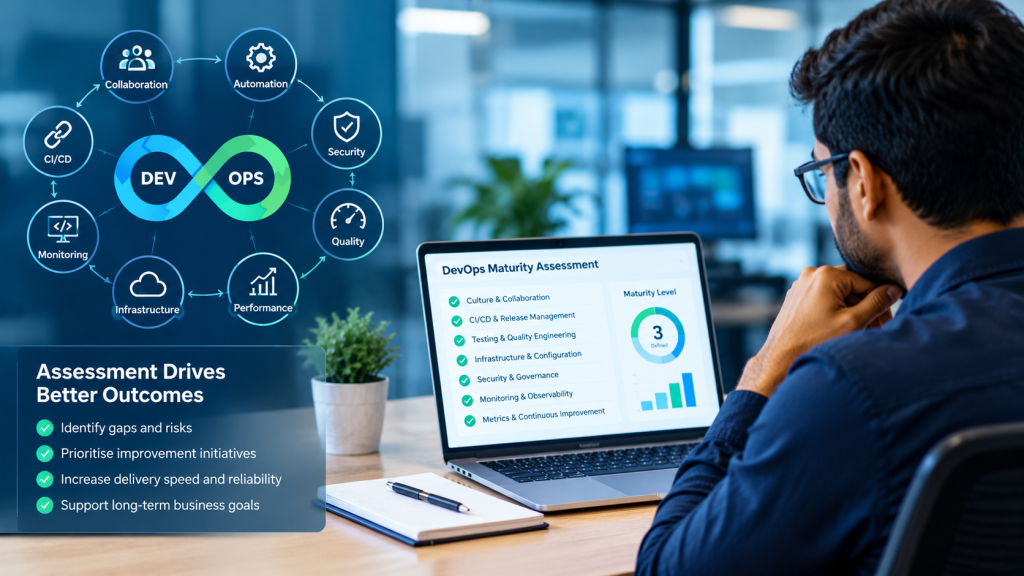
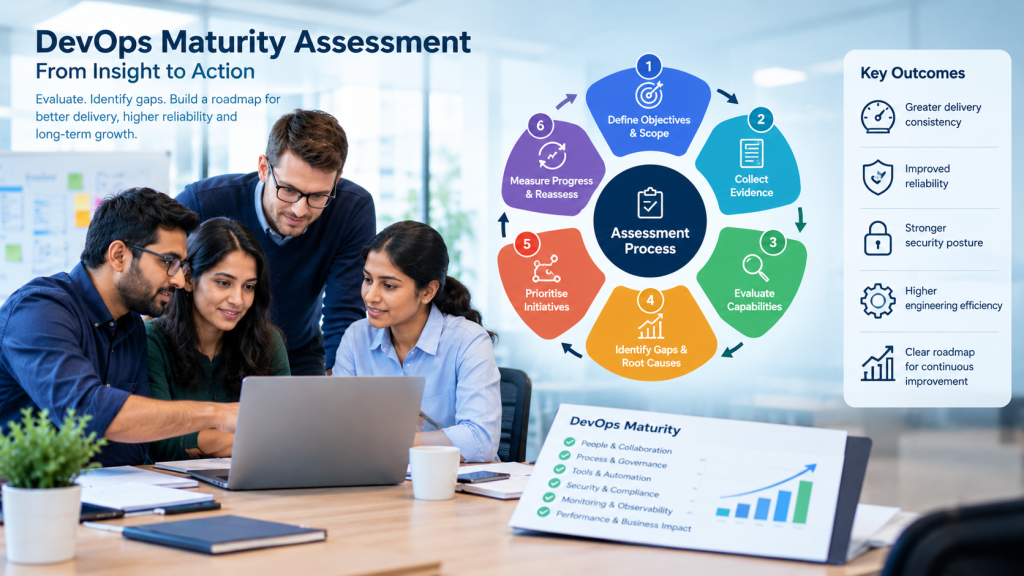
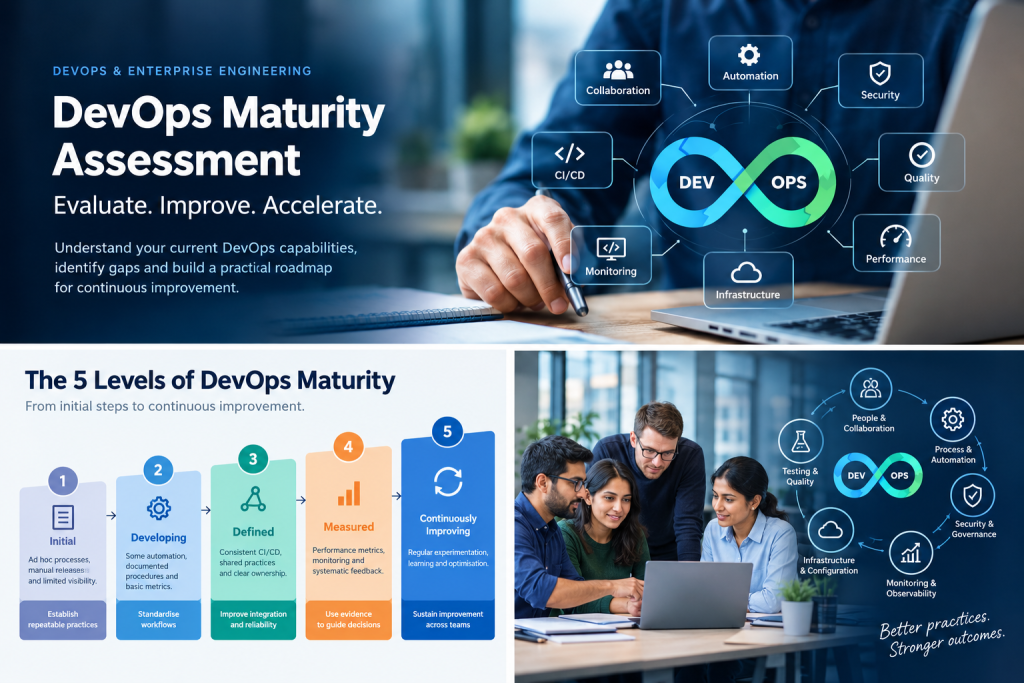
Sandhata applies the proprietary DevOps & SRE Maturity Compass to help banking technology leaders evaluate their dependency management practices across 30 to 40 technical, operational, and regulatory dimensions.
Level 1: Live Financial Dependency Coupling. Banking tests require live payment sandboxes, external credit agencies, and shared mainframe LPARs to be online simultaneously. Testing halts frequently due to batch windows and sandbox outages, vendor fees are high, and release cycles take quarters.
Level 2: Isolated Developer Code Stubs. Individual developers write simple static mocks for local unit testing, but integration, end-to-end, and performance suites still rely on fragile live staging environments. Mocks quickly become outdated as financial schemas evolve.
Level 3: Centralized Enterprise Banking Virtualisation. Stateful virtual services simulate critical payment networks, credit bureaus, and mainframe CICS/MQ interfaces across shared testing environments. Automated regression suites run continuously without external delays, and MIPS spend drops significantly.
Level 4: Autonomous Containerized Virtualisation and DORA Chaos Testing. Containerized virtual banking services deploy automatically inside ephemeral CI/CD pipelines. Schema updates regenerate virtual endpoints automatically, while continuous fault injection and latency modelling verify DORA operational resilience on every release.
The Maturity Compass provides banking executives with objective benchmark scores and a clear, phased roadmap for eliminating dependency bottlenecks.
Section 5: Enterprise Impact – Real-World Banking Virtualisation Case Studies
Case Study 1: Tier-1 Global Retail Bank Slashes Payment Testing Delays and MIPS Costs
A leading global retail bank struggled with severe testing bottlenecks across its digital banking app and payment processing platform. Testing new features required live connections to twenty-eight external clearinghouses, credit agencies, and fraud partners alongside core IBM mainframe ledgers. Vendor sandbox outages and LPAR contention delayed releases by four weeks, while high-volume automated test runs inflated annual MIPS expenses.
Sandhata deployed a dedicated team of Banking Service Virtualisation specialists to modernize the bank’s testing architecture. Sandhata virtualized all twenty-eight external financial APIs and core mainframe MQ/CICS interfaces, packaging them as automated Docker containers integrated directly into Jenkins CI/CD pipelines.
Environment wait time dropped by ninety-five percent, saving over twenty thousand engineering hours annually. Non-production mainframe MIPS consumption fell by thirty-eight percent, third-party sandbox fees dropped by eighty-eight percent, and release cycles accelerated from quarterly batches to bi-weekly digital updates.
Case Study 2: Major UK Commercial Bank Proves DORA Resilience with Virtual Fault Injection
A prominent UK commercial bank needed to accelerate its ISO 20022 payment modernization program while proving strict compliance with FCA, PRA, and DORA operational resilience rules. Live external clearing sandboxes could not simulate extreme network failures or malformed payment responses safely.
Sandhata engineered a stateful ISO 20022 Service Virtualisation solution featuring automated chaos fault injection, high-concurrency load simulation, and Playwright automated end-to-end testing.
End-to-end payment testing cycles accelerated by eighty-two percent, engineering teams validated over fifty severe third-party outage scenarios safely before production deployment, and automated compliance logs provided instant audit evidence for regulatory inspections.
Section 6: Essential Metrics for Banking Service Virtualisation Success
Measuring the strategic return on investment of Service Virtualisation for Banking Systems requires tracking objective operational metrics across speed, cost efficiency, and regulatory resilience:
Environment Wait Time Reduction: Measuring engineering hours saved by eliminating delays caused by unavailable payment sandboxes, credit bureaus, or mainframe batch windows.
Mainframe MIPS Consumption Reduction: Tracking direct savings in non-production mainframe CPU processing costs achieved by offloading test traffic to virtualized containers.
Third-Party Sandbox Fee Savings: Measuring reductions in recurring external vendor API transaction charges during automated regression and load testing.
DORA Resilience Scenario Coverage: Tracking the percentage of third-party outage, timeout, and malformed message recovery workflows validated via virtual fault injection.
Release Lead Time Acceleration: Measuring total time elapsed from code commit to production deployment across digital banking and payment channels.
Section 7: Frequently Asked Questions (FAQs)
FAQ 1: What is Service Virtualisation for Banking Systems?
Service Virtualisation for Banking Systems is an enterprise engineering discipline that simulates the functional behavior, financial messaging formats, and performance characteristics of external payment clearinghouses, credit bureaus, Open Banking APIs, and core legacy mainframes, allowing banks to execute continuous automated tests without waiting for live systems.
FAQ 2: Why do banks struggle with testing dependencies in traditional environments?
Banking applications rely on dozens of tightly coupled systems including SWIFT, Faster Payments, card schemes, KYC providers, and core IBM mainframes. External partner sandboxes have limited availability and strict transaction fees, while mainframe testing partitions are locked during nightly batch windows.
FAQ 3: How does Service Virtualisation reduce mainframe MIPS costs for banks?
Running high-volume automated regression and load tests directly against IBM Z mainframes consumes expensive MIPS processing capacity. Service Virtualisation captures and simulates mainframe CICS transactions and IBM MQ messages in lightweight cloud containers, offloading test traffic and reducing MIPS spend significantly.
FAQ 4: What financial messaging standards and protocols does Sandhata virtualise?
Sandhata virtualises all major banking and payment protocols including ISO 20022 XML, SWIFT MT/MX messages, ISO 8583 card authorization messages, REST, SOAP, GraphQL, IBM MQ, Apache Kafka, and mainframe CICS protocols.
FAQ 5: How does Service Virtualisation help banks meet DORA and PRA operational resilience rules?
Under DORA and PRA regulations, banks must prove their digital channels survive severe third-party outages. Virtual services simulate payment gateway crashes, extreme network lag, and corrupted clearinghouse responses safely, allowing banks to validate circuit breakers and disaster recovery workflows.
FAQ 6: How does Service Virtualisation eliminate third-party credit bureau and KYC sandbox fees?
External credit scoring agencies, anti-money laundering (AML) engines, and identity verification vendors frequently charge fees per API request even in testing environments. Virtualizing these external partners eliminates recurring sandbox transaction charges during automated regression and load testing.
FAQ 7: Can virtual banking services handle stateful multi-step transactions?
Yes. Enterprise virtual services maintain dynamic transaction state in memory. For example, a virtual core ledger can create a test account, process a debit transfer, update the remaining balance accurately, and reject subsequent overdraft requests realistically.
FAQ 8: How does Service Virtualisation accelerate Open Banking and PSD2 API testing?
Virtualizing third-party provider endpoints and core consent engines allows banking teams to test Open Banking APIs, OAuth token flows, and high-concurrency load limits continuously inside CI/CD pipelines.
FAQ 9: How does Sandhata ensure GDPR and PCI-DSS compliance when recording banking traffic?
When capturing network traffic to generate virtual services, Sandhata applies automated sensitive data discovery and deterministic masking to scrub real customer names, IBANs, and card numbers, replacing them with synthetic values.
FAQ 10: How does Service Virtualisation integrate with banking CI/CD pipelines?
Sandhata packages virtual banking services as version-controlled Docker containers alongside application code. CI/CD orchestrators like Jenkins, GitLab CI, and GitHub Actions deploy virtual services automatically during pull request builds and tear them down after Playwright and API suites finish.
FAQ 11: Can Service Virtualisation support core banking modernization and cloud migration?
Yes. Virtual services act as a stable architectural buffer during core banking transformations, simulating legacy mainframe modules while new cloud microservices are built and allowing dual-run behavioral validation.
FAQ 12: How does Sandhata’s ATOM2 platform enhance banking Service Virtualisation?
Sandhata’s ATOM2 hyperautomation platform orchestrates virtual service deployments, connects virtualized financial endpoints with automated end-to-end regression suites, and provides unified audit reporting.
FAQ 13: What metrics measure the ROI of Service Virtualisation for Banking Systems?
Key metrics include Environment Wait Time Reduction, Mainframe MIPS Cost Savings, Third-Party Sandbox Fee Reduction, Negative Resilience Scenario Coverage, and Release Lead Time.
FAQ 14: How does Sandhata assess a bank’s readiness for Service Virtualisation?
Sandhata applies the proprietary DevOps & SRE Maturity Compass to evaluate banking dependencies, mainframe constraints, payment partner bottlenecks, and regulatory requirements across 30 to 40 technical dimensions.
FAQ 15: How long does it take to implement Service Virtualisation for Banking Systems with Sandhata?
Initial dependency discovery and Maturity Compass assessments take 2 to 4 weeks. Building and deploying virtual services for critical payment networks and mainframe interfaces delivers measurable time and cost savings within 6 to 10 weeks.
Strategic Recommendation and Next Steps
Allowing digital banking innovation and automated quality pipelines to remain hostage to restricted payment sandboxes, oversubscribed mainframe partitions, and recurring third-party transaction fees slows time-to-market and inflates operating expenses. To lead in modern financial services, banking technology executives must decouple testing from live external and legacy dependencies.
Service Virtualisation for Banking Systems provides the speed, financial precision, and resilience modern banks require. By simulating ISO 20022 payment networks, decoupling core mainframe CICS/MQ interfaces to save MIPS, injecting DORA chaos fault scenarios, and deploying containerized virtual services inside CI/CD pipelines, financial institutions accelerate digital releases while protecting customer trust.
Sandhata Technologies brings over two decades of proven engineering excellence serving tier-1 global banks, payment clearinghouses, and financial institutions.
Contact Sandhata’s Banking Service Virtualisation Specialists today to schedule your DevOps & SRE Maturity Compass Assessment and eliminate dependency bottlenecks across your financial delivery pipelines.