
Technical Framework & Protocols: Lift Breakdown Assistance in Hyderabad
Table of Contents
Technical Framework & Protocols: Lift Breakdown Assistance in Hyderabad
When an elevator experiences an unexpected operational halt or critical failure, immediate dispatch of specialized elevator breakdown response teams is vital to ensure structural integrity, prevent passenger injury, and restore vertical transportation. In Hyderabad’s rapidly evolving urban hubs—ranging from high-tech commercial clusters like HITEC City, Gachibowli, Financial District, and Kondapur to dense residential ecosystems such as Banjara Hills, Jubilee Hills, Kukatpally, Miyapur, Kompally, and Uppal—factors like sudden voltage spikes, monsoon-induced pit flooding, worn-out brake shoes, and degraded electronics frequently cause breakdown incidents.
This operational guide details the technical procedures, diagnostic workflows, compliance requirements, and structural schemas for executing lift breakdown assistance in Hyderabad.


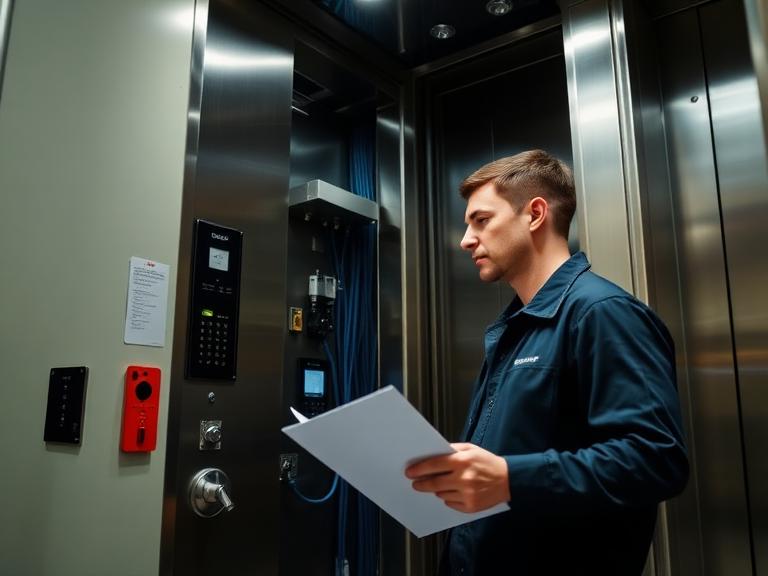
1. Breakdown Root Causes & Technical Diagnostic Pathways
A breakdown differs from a standard landing entrapment; it involves electrical, mechanical, or structural faults that prevent the elevator controller from clearing its internal safety circuit.
                      [ Elevator System Tripped / Off-Line ]
                                        │
                                        ▼
                        [ System Error Code Logic Check ]
                                        │
         ┌──────────────────────────────┼──────────────────────────────┐
         ▼                              ▼                              ▼
┌─────────────────┐           ┌─────────────────┐           ┌─────────────────┐
│ Electrical Loop │           │  Drive / Motor  │           │ Mechanical Link │
├─────────────────┤           ├─────────────────┤           ├─────────────────┤
│ • Phase Reverse │           │ • VFD Over-Temp │           │ • Door Clutch   │
│ • Voltage Surge │           │ • Encoder Drift │           │ • Rope Tension  │
│ • Safety Switch │           │ • Brake Coil    │           │ • Governor Lock │
└─────────────────┘           └─────────────────┘           └─────────────────┘
         │                              │                              │
         └──────────────────────────────┼──────────────────────────────┘
                                        ▼
                   [ Field Technician Technical Dispatch ]
Common Mechanical & Electrical Failure Profiles
- Phase Sequence & Voltage Inconsistency: Sudden power transfers between grid lines and diesel generator sets across Hyderabad’s industrial corridors can cause transient phase reversals or under-voltage events ($<360\text{V AC}$). Main phase-monitoring relays trip to protect drive electronics from phase-loss damage.
- VFD Inverter Module Faults: Variable Frequency Drives regulate motor speed, acceleration, and deceleration profiles. Dust accumulation, combined with high ambient temperature in overhead machine rooms, causes thermal overload trips in the IGBT (Insulated Gate Bipolar Transistor) modules.
- Door Clutch & Interlock Misalignment: Mechanical wear on the car door clutch mechanisms or debris build-up in the landing door sill tracks prevents physical interlock closure. Without an established 24V DC safety loop through every door contact, the elevator controller locks the drive out completely.
- Brake Shoe Misalignment & Coil Failure: Electro-mechanical brakes rely on continuous DC voltage to hold brake pads open against heavy spring pressure. Coil deterioration or thermal expansion can cause uneven pad drag, triggering drive-overcurrent fault codes during run cycles.
2. Drive System Breakdown Matrix & Field Responses
Different elevator architectures require specialized troubleshooting tools and diagnostic workflows to recover from a breakdown safely.
| Fault Parameter / System | Geared Traction Elevator | Gearless Machine-Room-Less (MRL) | Hydraulic Lift System |
| Typical Breakdown Symptom | Heavy vibration, gear slippage, coil over-temperature | Controller drive trip, encoder fault code (E-code) | Overheating oil, pump Cavitation, descent failure |
| Primary Inspection Zone | Overhead Machine Room | Top Landing Hoistway Control Cabinet | Ground/Basement Hydraulic Power Unit |
| Diagnostic Tool | Mechanical Tachometer & Megohmmeter | Handheld Service Tool / CAN-Bus Analyzer | Hydraulic Pressure Gauge & Flow Meter |
| Critical Component Replaced | Worm gear oil, brake pads, contactor points | Encoder cable, VFD drive board, magnetic sensors | Solenoid valves, hydraulic oil seals, pump filters |
| Average Repair Duration | 2 to 4 Hours | 1 to 3 Hours | 2 to 3 Hours |
3. Step-by-Step Lift Breakdown Response Protocol
All emergency repair and breakdown interventions must comply with IS 14665 standards and guidelines set by the Telangana Chief Electrical Inspectorate to Government (CEIG).
1.Phase 1: Site Perimeter Isolation & Danger Tagging:Apply LOTO Procedures & Secure the Site.
- Arrive at the site and set up physical warning barricades at every landing door to prevent occupants from approaching the elevator entrance.
- Disconnect the main three-phase supply switch ($415\text{V AC}$) at the main distribution board and apply Lockout/Tagout (LOTO) padlocks to prevent accidental power restoration during diagnostics.
2.Phase 2: Controller Interface & Electrical Audit:Connect Diagnostic Interface & Evaluate Fault Codes.
- Access the controller cabinet in the machine room or top-floor door frame.
- Connect the proprietary diagnostic service tool to read stored fault logs and verify the safety circuit status (e.g., pit switch, governor switch, door contacts).
- Test input voltages across all three phases ($L1, L2, L3$) to ensure supply stability within standard tolerances ($\pm 10\%$).
3.Phase 3: Mechanical Alignment & Component Replacement:Repair or Replace Damaged Components.
- Door Circuits: Clean landing door sill grooves, adjust car door drive belts, align clutch rollers, and replace damaged contact pads.
- Brake Assembly: Inspect mechanical brake shoe clearance, measure coil resistance, and set air gaps using feeler gauges to ensure uniform release.
- Drive Subsystem: Clear VFD thermal trip codes, replace worn cooling fans, and recalibrate motor encoder positions if positional drift occurs.
4.Phase 4: Safety Circuit Inspection & Test Runs:Verify Operational Parameters Before Service Restoration.
- Remove LOTO padlocks and restore low-voltage control power to verify safety loop continuity.
- Execute slow-speed inspection runs from the car top or controller panel to verify smooth travel through the entire hoistway.
- Verify that floor levelling accuracy remains within $\pm 5\text{ mm}$ at all landing stops.
5.Phase 5: Field Logging & Preventive Service Release:Document Diagnostics & Return to Service.
- Re-lock all controller panel doors and machine room access hatches securely.
- Document the root cause, parts replaced, and operational metrics in the digital field log.
- Provide a copy of the breakdown clearance report to the building management team before clearing the unit for public use.
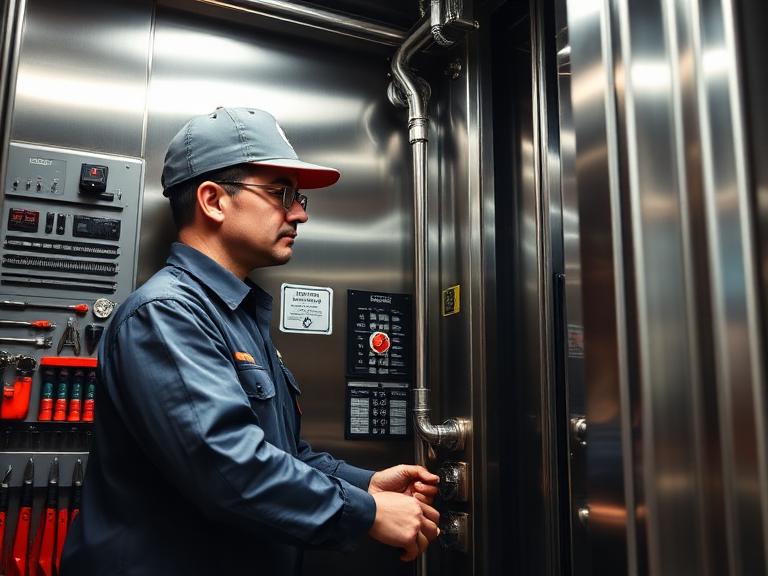
4. Emergency Troubleshooting Matrix for Technicians
When an elevator system remains unoperational after clearing primary fault codes, refer to this matrix to identify deep-level component failures.
                  [ Complex Breakdown Diagnostic Tree ]
                                    │
    ┌───────────────────────────────┼───────────────────────────────┐
    ▼                               ▼                               ▼
┌───────────────────────┐┌───────────────────────┐┌───────────────────────┐
│ Elevator Safety Trip  ││ VFD Inverter Lockout  ││ Door Interlock Fault  │
├───────────────────────┤├───────────────────────┤├───────────────────────┤
│ • Governor tripped    ││ • IGBT short circuit  ││ • Roller worn out     │
│ • Pit buffer open     ││ • DC bus overvoltage  ││ • Interlock contacts  │
│ • Final limit engaged ││ • Heatsink clogged    ││   pitted or oxidized  │
└───────────────────────┘└───────────────────────┘└───────────────────────┘
Advanced Diagnostics for Persistent Breakdown Conditions
- Safety Circuit Opened by Overspeed Governor:
- Symptom: The main line contactor will not energize, and the controller reports an open safety circuit fault.
- Root Cause: Minor rope slippage or sudden car jolting tripped the mechanical governor switch in the overhead space.
- Solution: Access the overhead machine space or MRL governor bracket, inspect the tension pulley, reset the mechanical trip lever manually, and clear the safety loop lock on the main board.
- DC Bus Overvoltage Faults During Deceleration:
- Symptom: The VFD drive trips with an overvoltage error code whenever the elevator car decelerates near a landing zone.
- Root Cause: The dynamic braking resistor (DBR) circuit is open, or the DBR resistor unit has failed due to excessive heat dissipation.
- Solution: Test DBR terminal resistance with a multimeter; replace burnt braking resistor elements and ensure proper ventilation around the resistor enclosure.
- Intermittent Door Interlock Bouncing:
- Symptom: The car arrives at a floor, the doors attempt to close, but the elevator repeatedly reopens and fails to launch.
- Root Cause: Pitched alignment on the landing door optical sensors or oxidized interlock copper contacts causing momentary resistance spikes ($>5\ \Omega$).
- Solution: Clean all door sill optical sensors, sand or replace oxidized mechanical copper contact points, and re-square the landing door hanger brackets.
5. Frequently Asked Questions (FAQs)
1. What qualifies as an emergency lift breakdown in Hyderabad?
An emergency breakdown includes complete power failure to the elevator car, door failure preventing entrance or exit, mechanical lockouts causing inter-floor halts, unusual noises from the motor room, or uncoordinated movement during operation.
2. What is the typical response time for lift breakdown assistance in Hyderabad?
Emergency breakdown response units cover major commercial and residential areas—such as HITEC City, Gachibowli, Financial District, Kondapur, Banjara Hills, and Jubilee Hills—with response times between 30 to 45 minutes depending on local traffic.
3. Why does my building’s lift trip frequently during the monsoon season?
Monsoon rains increase humidity levels and can lead to water seepage in elevator pits or top-floor machine rooms. Excess moisture short-circuits door contacts, damages pit safety switches, and causes voltage fluctuations that trip safety circuits.
4. Can a breakdown service fix elevators of any brand or make?
Yes. Professional breakdown assistance providers employ multi-brand technicians equipped with universal diagnostic interfaces, allowing them to troubleshoot systems manufactured by Otis, KONE, Schindler, Mitsubishi, Thyssenkrupp (TK Elevator), Johnson, and local OEM brands.
5. What should facility managers do while waiting for a repair technician?
Facility managers should immediately isolate power to the affected elevator at the main switch, place “Out of Service” warning signs on all landing doors, and ensure no unauthorized personnel attempt to force doors open or enter the hoistway.
6. Why does an elevator controller show a “Safety Circuit Open” fault code?
This fault occurs when any safety device in the continuous series circuit—such as the emergency stop button, top/bottom final limit switches, overspeed governor switch, or landing door interlock contacts—breaks continuity.
7. How often should elevators in Hyderabad undergo breakdown prevention maintenance?
Per local regulatory guidelines and safety standards, passenger elevators should undergo comprehensive preventive maintenance once every month to check brake clearances, lubricate guide rails, clean door contacts, and test safety circuits.
8. What causes an elevator to lose floor levelling accuracy?
Improper floor levelling ($>5\text{ mm}$ gap) usually points to worn magnetic floor sensors, encoder signal loss, stretched elevator suspension ropes, or improper VFD deceleration curve parameters.
9. What is the difference between an AMC breakdown visit and emergency rescue assistance?
Emergency rescue assistance focuses specifically on rapid passenger extraction when people are trapped inside a car. An AMC breakdown visit involves technical diagnostics, component repairs, electrical troubleshooting, and restoring the elevator system to service.
10. Is it necessary to replace ARD batteries during a breakdown repair?
If the breakdown was caused by an unexpected main line power drop where the Automatic Rescue Device (ARD) failed to engage, testing and replacing old or degraded $12\text{V DC}$ lead-acid/gel battery packs is necessary.
11. Can a burnt VFD inverter drive be repaired on-site?
Minor issues like broken cooling fans or control card faults can be repaired on-site. Major IGBT power module failures typically require removing the VFD unit for bench testing, component replacement, and load testing in a specialized lab.
12. What documents must be provided after a lift breakdown repair is completed?
Technicians should provide a formal Service Breakdown Report detailing the root cause, electrical/mechanical diagnostic findings, list of replaced parts, safety test results, and final clearance for operation.
13. What statutory rules govern elevator operations and breakdowns in Telangana?
Elevator operations in Telangana are governed by the Telangana Lifts, Escalators, and Passenger Conveyors rules, monitored by the Chief Electrical Inspectorate to Government (CEIG), requiring valid Form-B operating permits and regular safety compliance checks.
14. What causes noisy elevator operation before a total breakdown?
Grinding or squealing noises usually indicate dry or misaligned guide shoes, unlubricated T-rails, worn motor bearings, or loose counterweight inserts rubbing against structural frame brackets.
15. How can building management reduce recurring lift breakdowns?
Building managers can reduce breakdowns by opting for regular preventive AMC maintenance, replacing aging ARD batteries, installing voltage stabilizers and surge protection devices, keeping machine rooms cool, and addressing small door or noise issues early.