Enterprise Continuous Delivery Consulting | CI/CD Transformation | Sandhata
Table of Contents
Enterprise Continuous Delivery Consulting | CI/CD Transformation | Sandhata
To maintain a competitive advantage in fast-moving digital markets, enterprise organizations must deliver digital capabilities, application enhancements, and regulatory updates rapidly and predictably. However, inside large-scale enterprise environments, accelerating software releases presents significant operational complexity.
Enterprise IT ecosystems do not consist of simple standalone applications. Instead, enterprise business processes span hundreds of interconnected microservices, public and private clouds, middleware message buses, third-party payment gateways, and core legacy mainframes. Coordinating software changes across these multi-tier architectures using legacy release management, manual testing cycles, and paper-based change control forms creates severe delivery friction.



Manual release approaches result in long delivery timelines, high operational costs, developer burnout, and elevated release failure rates. Crucially, manual verification steps fail to prevent unexpected production outages or configuration drift.
Continuous Delivery Consulting resolves these systemic bottlenecks. By transforming software release pipelines, embedding automated quality gates, shifting security checks left, and virtualizing legacy dependencies, organizations convert software delivery into a reliable, repeatable, and low-risk operational capability.
This comprehensive guide details the engineering methodologies, architectural patterns, and governance models that Sandhata Technologies delivers to help regulated enterprise clients achieve continuous release agility.
Section 1: The Enterprise Continuous Delivery Challenge
While the benefits of continuous delivery are widely recognized, achieving continuous release flow inside complex enterprise environments requires addressing distinct structural obstacles.
1.1 Legacy Release Friction and Slow Cycle Times
In traditional enterprise setups, software delivery moves through slow, fragmented handoffs. Developers write code in isolation, queue changes for manual testing cycles, submit documentation to Change Advisory Boards, and wait for scheduled weekend release windows.
This fragmented workflow extends lead times from weeks to quarters. Because code updates accumulate into massive, complex release batches over long periods, identifying the cause of unexpected bugs becomes difficult, leading to prolonged troubleshooting and frequent deployment rollbacks.
1.2 The Bottleneck of Manual Quality Assurance and Environment Wait Times
Testing enterprise software across complex application stacks represents a major release bottleneck. Manual test execution across extensive regression suites takes weeks to complete.
Furthermore, engineering teams frequently encounter long delays waiting for shared, fixed staging environments or unavailable third-party services. When staging environments suffer from configuration drift or incomplete test data, test results become unreliable, allowing hidden defects to reach production systems.
1.3 Regulatory Compliance and Risk Aversion
In heavily regulated industries such as banking, insurance, telecommunications, and healthcare, software changes must satisfy strict regulatory compliance mandates.
Organizations historically attempted to satisfy these compliance mandates using manual review steps, static documentation, and segregation of duties rules enforced via spreadsheet handoffs. These manual processes slow release velocity without guaranteeing operational resilience or security compliance.
Section 2: Core Engineering Pillars of Sandhata’s Continuous Delivery Consulting Services
Sandhata Technologies provides specialized Continuous Delivery Consulting services designed to overcome these enterprise challenges. Sandhata combines modern continuous integration automation, automated quality engineering, legacy integration frameworks, and Policy as Code governance into a unified delivery strategy.
2.1 Pillar 1: Strategic Assessment and Pipeline Blueprinting
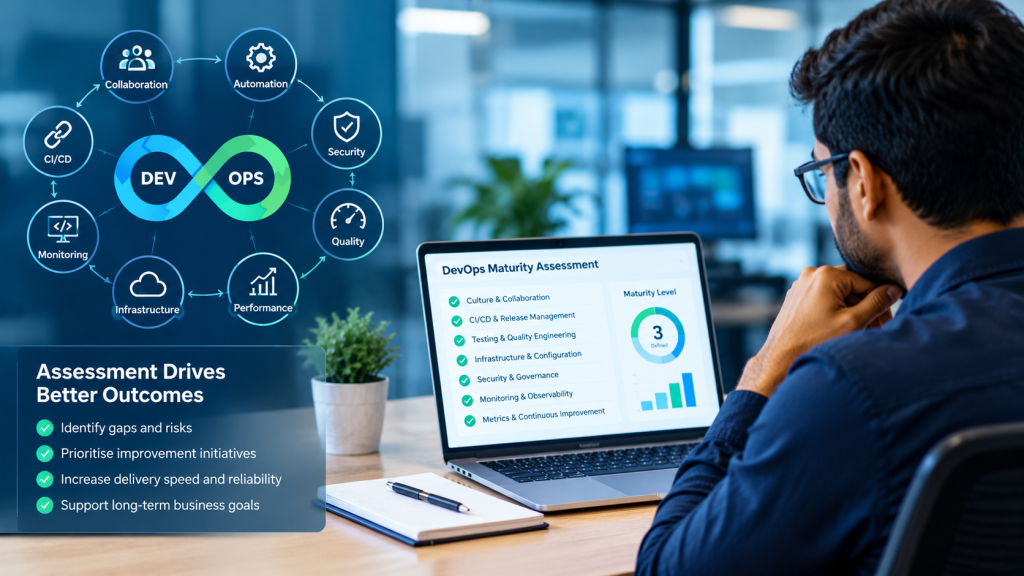
Every enterprise continuous delivery journey begins with establishing clear operational baselines. Sandhata applies the proprietary DevOps & SRE Maturity Compass to evaluate an organization’s delivery capabilities across 30 to 40 measurement dimensions.
Sandhata consultants audit source control practices, continuous integration configurations, automated test coverage, environment provisioning workflows, security scanning tools, and release governance processes. This deep diagnostic uncovers exact delivery bottlenecks, exposes hidden technical debt, and establishes a clear, phased modernization roadmap.
2.2 Pillar 2: Standardized Multi-Cloud CI/CD Pipeline Automation
Sandhata designs and constructs robust, scalable continuous integration and continuous delivery pipelines across multi-cloud architectures including Amazon Web Services, Microsoft Azure, Google Cloud Platform, and private enterprise data centers.
By creating reusable, modular pipeline templates, Sandhata enables engineering teams to automate code compilation, container creation, artifact publishing, dynamic test execution, and zero-downtime production deployments. Pipeline automation eliminates manual intervention steps, ensuring every code commit moves through identical, repeatable verification gates.
2.3 Pillar 3: Shift-Left Quality Engineering and Service Virtualization
Continuous delivery is impossible without automated quality engineering. Sandhata embeds automated testing directly into delivery pipelines, shifting quality validation left into early development stages.
Unit tests, automated integration suites, contract tests, and performance benchmarks execute automatically during every build. To eliminate dependencies on unavailable third-party payment endpoints or core legacy databases, Sandhata implements Service Virtualization.
Service Virtualization simulates complex downstream interface responses, allowing integration testing to run continuously in lower environments without waiting for physical target systems or risking live production systems.
2.4 Pillar 4: DevSecOps and Policy as Code Compliance
Sandhata integrates security and regulatory compliance directly into automated pipelines, replacing manual Change Advisory Board reviews with Policy as Code governance.
Automated static code analysis, open-source license scanning, container vulnerability checks, and dynamic security validation execute automatically during pipeline runs. Simultaneously, automated governance engines check infrastructure configuration scripts against strict regulatory mandates such as DORA, PRA rules, PCI-DSS, and GDPR.
Non-compliant software builds are automatically blocked in the pipeline, giving developers immediate feedback. Crucially, the pipeline generates tamper-proof, immutable audit logs for every build, providing continuous audit readiness for regulators.
2.5 Pillar 5: Hybrid Cloud and Legacy Mainframe Pipeline Synchronization
Enterprise applications frequently rely on legacy mainframes operating alongside modern cloud microservices. Achieving true continuous delivery requires synchronizing release flows across both environments.
Sandhata connects traditional mainframe application lifecycles to modern Git version control platforms and modern CI/CD runners. Mainframe code compiles, builds, and automated regression tests run alongside cloud microservice pipelines, enabling coordinated, low-risk releases across the entire application ecosystem.
2.6 Pillar 6: Ephemeral Environments and Dynamic On-Demand Testing
Fixed, long-lived staging environments create continuous scheduling conflicts between development teams and consume unnecessary cloud budgets during idle hours. Sandhata implements automated ephemeral environments.
When a software engineer submits a new feature or pull request, the CI/CD pipeline automatically provisions an isolated, temporary cloud testing environment using Infrastructure as Code. Automated test suites execute, and once testing completes, the temporary environment dismantles automatically. This approach accelerates testing cycles, isolates code changes, and dramatically reduces cloud compute expenditure.
Section 3: Evaluating Continuous Delivery Maturity with the Maturity Compass
Sandhata applies the DevOps & SRE Maturity Compass to help enterprise technology leaders benchmark their delivery practices and guide strategic transformation investments.
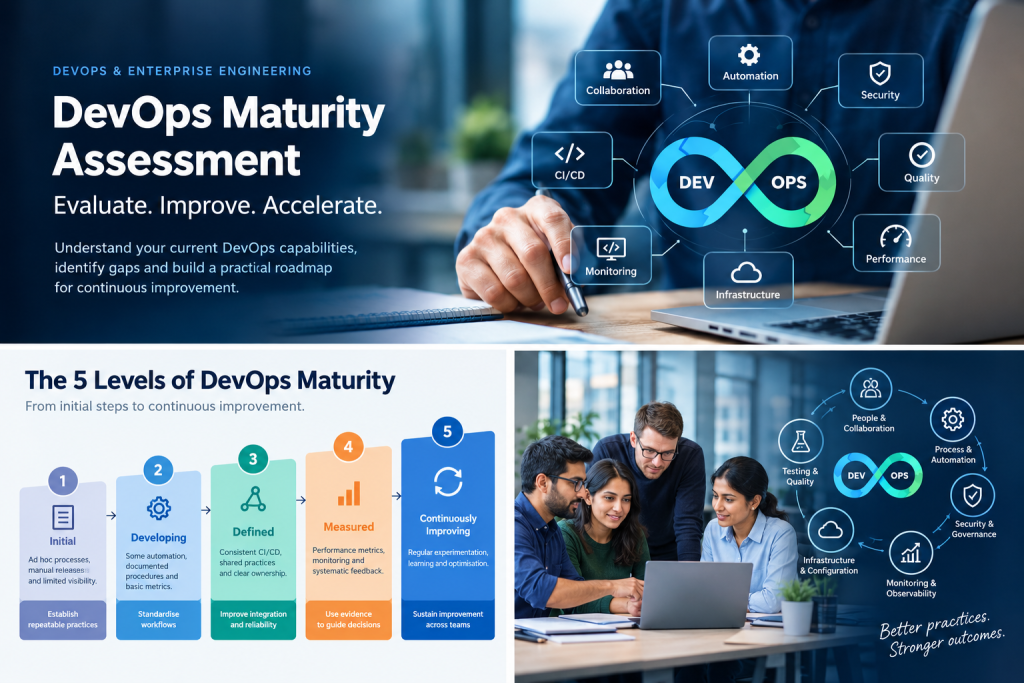
Level 1: Manual Release Management. Software releases rely on manual deployment steps, paper checklists, spreadsheet tracking, and manual weekend deployment windows. Lead times take months, environment configuration drift is common, and change failure rates remain high.
Level 2: Basic CI Build Automation. Continuous integration tools automate local code compilation and basic unit testing. However, integration testing, security reviews, environment provisioning, and deployment governance remain manual processes.
Level 3: Automated Continuous Delivery Pipelines. CI/CD pipelines automate deployments across staging and production environments. Automated security checks, Policy as Code governance, and Service Virtualization run during build cycles, while audit evidence logs collect centrally.
Level 4: Advanced Continuous Delivery and Progressive Releases. Enterprise releases deploy continuously using zero-downtime Blue-Green and Canary rollout strategies. Ephemeral environments validate features dynamically, while automated SRE telemetry triggers instant rollbacks during runtime anomalies.
The Maturity Compass provides senior executive leadership with absolute visibility into delivery bottlenecks, compliance risks, and strategic steps to achieve modern continuous delivery.
Section 4: Enterprise Impact – Real-World Continuous Delivery Case Studies
Case Study 1: Global Retail Bank Modernizes Core Banking Release Cadence
A major global retail bank struggled with slow delivery cycles across its core banking and digital mobile applications. Manual change approvals, disconnected team silos, and legacy mainframe testing dependencies caused software release lead times to average 14 weeks.
Sandhata deployed a dedicated team of Continuous Delivery Consultants to redesign the bank’s delivery architecture. Sandhata implemented standardized CI/CD pipelines, integrated Policy as Code governance, and deployed Service Virtualization for core ledger APIs.
Software release lead times dropped by 78%, decreasing from 14 weeks to under 3 weeks. Deployment frequency increased from quarterly release batches to weekly delivery updates, while automated audit logging saved thousands of manual audit preparation hours annually.
Case Study 2: Major Telecommunications Provider Zero-Downtime Billing Modernization
A global telecommunications provider struggled with recurring maintenance downtime when deploying updates to its online billing engine. Deployment errors frequently caused billing system outages, resulting in customer service calls and lost revenue.
Sandhata engineered an enterprise continuous delivery solution incorporating automated pipeline validation, ephemeral testing environments, and Canary deployment strategies.
Deployment failure rates fell from 11% to under 0.4%. The provider eliminated weekend maintenance downtime completely, running seamless zero-downtime updates during regular business hours while maintaining system availability at 99.999%.
Section 5: Key Metrics for Continuous Delivery Success
Evaluating the strategic return on investment of a Continuous Delivery transformation requires monitoring core performance indicators across speed, reliability, quality, and efficiency:
Deployment Frequency: Evaluates how often production releases occur. High-performing organizations transition from quarterly releases to continuous daily updates.
Lead Time for Changes: Measures the duration required for a committed code change to pass through build, test, compliance checks, and production release.
Change Failure Rate: Measures the percentage of production deployments causing immediate errors, defects, or emergency rollbacks. High-performing teams maintain change failure rates under 5%.
Mean Time to Restore (MTTR): Measures how quickly operational services recover when production failures occur. Automated rollbacks reduce MTTR to minutes.
Automated Test Pass Rate: Measures the percentage of pipeline automated tests executing successfully without manual intervention.
Audit Preparation Time: Evaluates the time required to gather change documentation for regulatory audits, reduced from weeks to seconds via automated pipeline logging.
Section 6: Frequently Asked Questions (FAQs)
FAQ 1: What is Continuous Delivery Consulting?
Continuous Delivery Consulting is a specialized advisory and engineering service that helps enterprise organizations establish automated software release pipelines, shift testing left, automate security governance, and integrate complex legacy and cloud architectures to achieve fast, predictable, and low-risk software releases.
FAQ 2: How does Continuous Delivery differ from Continuous Deployment?
Continuous Delivery ensures that code changes are automatically validated, tested, and kept in a release-ready state, allowing business stakeholders to deploy updates to production on demand. Continuous Deployment goes one step further by automatically releasing every validated code change into production without manual human authorization.
FAQ 3: How does Continuous Delivery operate in heavily regulated industries like banking and healthcare?
In regulated sectors, Continuous Delivery replaces manual audit approvals with Policy as Code and automated pipeline gates. Immutable execution logs capture developer identity, security scans, test execution passes, and peer approvals automatically, maintaining full regulatory compliance for standards such as DORA, PRA, PCI-DSS, and HIPAA.
FAQ 4: How does Sandhata integrate legacy mainframes into continuous delivery pipelines?
Sandhata connects legacy mainframe platforms to modern Git version control systems using custom API adapters, specialized automated test frameworks, and Service Virtualization, synchronizing release cadences between core legacy applications and cloud microservices.
FAQ 5: What role does Service Virtualization play in Continuous Delivery Consulting?
Service Virtualization simulates third-party APIs, legacy mainframes, and external payment networks, allowing continuous integration pipelines to execute automated integration tests without waiting for physical environment dependencies or risking production systems.
FAQ 6: How does continuous delivery improve software quality and lower defect rates?
Continuous delivery executes automated unit, integration, security, and performance test suites during every code check-in. Catching defects early in the development lifecycle prevents bugs from reaching staging or production environments, dramatically reducing change failure rates.
FAQ 7: What is Shift-Left Security in continuous delivery pipelines?
Shift-Left Security embeds static code analysis, open-source dependency scanning, container image inspection, and vulnerability checks directly into early pipeline stages, allowing developers to identify and resolve security risks while writing code.
FAQ 8: How does Sandhata evaluate an enterprise’s continuous delivery maturity level?
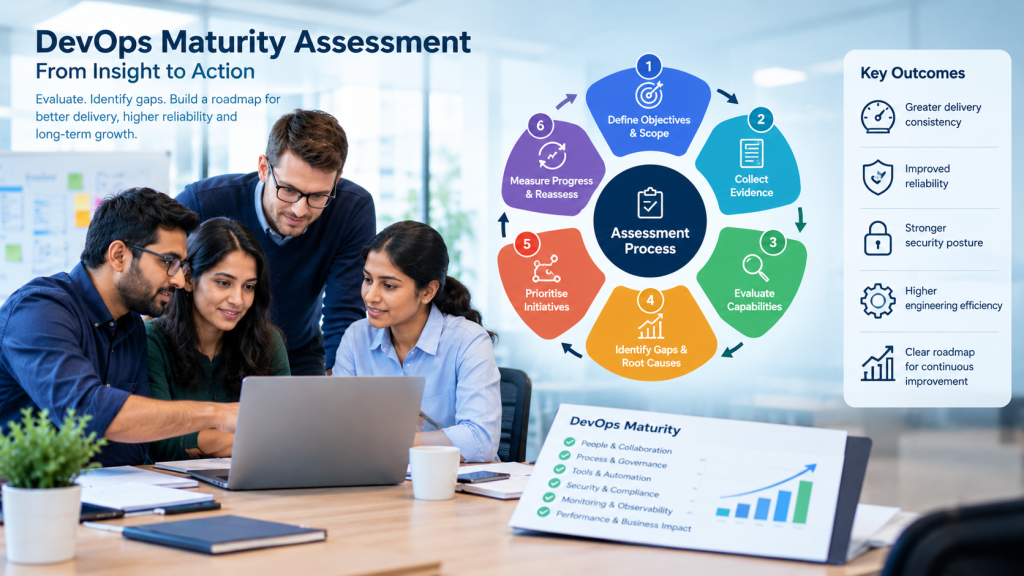
Sandhata uses the proprietary DevOps & SRE Maturity Compass to audit enterprise delivery workflows across 30 to 40 measurement dimensions, identifying friction points, security risks, and technical debt to build a targeted transformation roadmap.
FAQ 9: How do ephemeral environments support continuous delivery workflows?
Ephemeral environments are dynamic, short-lived cloud testing setups automatically provisioned for specific feature branches. Once automated tests finish executing, the environment terminates automatically, reducing infrastructure spend and eliminating scheduling bottlenecks.
FAQ 10: What are the key DORA metrics used to measure continuous delivery success?
The core DORA metrics are Deployment Frequency, Lead Time for Changes, Change Failure Rate, and Mean Time to Restore (MTTR).
FAQ 11: How does continuous delivery eliminate Change Advisory Board (CAB) release bottlenecks?
Continuous delivery converts manual CAB reviews into automated Policy as Code governance. When a code release satisfies all automated unit, integration, performance, and security policy checks, release authorization is granted programmatically based on verifiable evidence.
FAQ 12: What tools and technologies are commonly implemented during Continuous Delivery engagements?
Sandhata integrates modern toolchains including Git-based version control platforms, Jenkins, GitLab CI, GitHub Actions, Terraform, Ansible, Docker, Kubernetes, Playwright, Selenium, and Sandhata’s ATOM2 hyperautomation framework.
FAQ 13: How does Sandhata prevent environment configuration drift across multi-cloud setups?
Sandhata implements declarative Infrastructure as Code and immutable environment models. Environments are defined in version-controlled scripts, ensuring that development, testing, staging, and production environments remain completely identical and repeatable.
FAQ 14: How does continuous delivery support financial API and Open Banking enablement?
Continuous delivery automates contract testing, API gateway validation, and security scanning for financial microservices, allowing banks to roll out secure Open Banking features rapidly without risking core transaction uptime.
FAQ 15: How long does a Continuous Delivery Consulting transformation engagement take with Sandhata?
Discovery audits and Maturity Compass assessments require 2 to 4 weeks. Core pipeline engineering, automated test integration, and pilot team migrations typically yield measurable operational gains within 8 to 12 weeks.
Strategic Recommendation and Next Steps
Relying on legacy release management, manual testing cycles, spreadsheet schedules, and manual change control gates exposes enterprise organizations to severe operational risk, high costs, and competitive disadvantage. To thrive in digital-first markets, enterprise leaders must transition to continuous, automated, and secure software delivery.
Continuous Delivery Consulting offers a proven methodology for enterprise transformation. By building standardized CI/CD pipelines, shifting quality and security validation left, integrating legacy mainframe platforms, and embedding automated Policy as Code governance, enterprises can accelerate software delivery while maintaining absolute stability and regulatory compliance.
Sandhata Technologies brings over two decades of engineering excellence in DevOps consulting, quality automation, and enterprise release orchestration across heavily regulated industries.
Contact Sandhata’s Continuous Delivery Consulting Specialists today to schedule your DevOps & SRE Maturity Compass Assessment and modernize your software delivery capabilities.