DevOps for Financial Services | Enterprise Modernization & Banking Automation | Sandhata
Table of Contents
DevOps for Financial Services | Enterprise Modernization & Banking Automation | Sandhata
Global financial institutions operate in an intensely competitive and heavily monitored technology environment. Retail banks, investment firms, payment processors, and wealth management platforms must innovate continuously to deliver modern digital experiences, open banking APIs, and real-time payment solutions.
However, achieving release speed in financial services presents significant technical complexity. Financial institutions rely on massive, highly complex technology stacks. Modern mobile banking applications must communicate across multi-cloud infrastructure, middleware layers, payment gateways, and core legacy mainframes containing decades of transactional data. Furthermore, regulatory bodies require complete auditability, strict data protection, operational resilience, and robust risk management.



Historically, financial institutions relied on manual change approval processes, manual testing, and disconnected development silos to mitigate operational risk. This traditional approach resulted in release cycles spanning quarters, high operational costs, and frequent deployment errors caused by manual processes.
DevOps for Financial Services resolves this challenge. By introducing automated pipeline governance, legacy mainframe integration, Policy as Code, DevSecOps, and Service Virtualization, financial institutions can accelerate software release cycles while maintaining ironclad security and full regulatory compliance.
This comprehensive guide presents the architectural frameworks, implementation strategies, and operational methodologies that Sandhata Technologies utilizes to drive successful DevOps transformations across global financial institutions.
Section 1: The Technical Landscape of Enterprise Financial Technology
To implement DevOps effectively in financial services, modern delivery pipelines must account for the unique architectural complexities of banking environments.
1.1 Core Mainframe Dependencies and Technical Debt
Core banking platforms handle foundational transactions, ledger balances, trade settlements, and account management. Many of these systems rely on legacy mainframes operating application code built over several decades.
Traditional mainframe development relies on batch deployments, manual build steps, and specialized developer tools disconnected from modern cloud workflows. When modern mobile banking applications require core ledger changes, development teams encounter major bottlenecks due to mismatched release rhythms between rapid cloud releases and slow mainframe release cycles.
1.2 Complex Third-Party Ecosystems and Payment Networks
Financial platforms operate within connected banking ecosystems, communicating with SWIFT payment networks, card clearing houses, credit scoring agencies, and regulatory reporting engines. Running reliable end-to-end tests across these complex external networks is exceptionally difficult, as third-party test environments are often unavailable, expensive to access, or populated with static test data.
1.3 Strict Operational Risk and Regulatory Standards
Financial software systems manage critical financial infrastructure and highly sensitive personal data. Consequently, regulatory mandates enforce strict compliance across global operations.
The Digital Operational Resilience Act mandates rigorous operational resilience, continuous vulnerability management, and documented incident recovery mechanisms across financial IT infrastructure.
Prudential Regulation Authority mandates enforce robust operational risk management, strict change logging, and continuous audit readiness.
Payment Card Industry Data Security Standard mandates absolute isolation of payment processing environments, mandatory data encryption, continuous vulnerability testing, and verifiable segregation of duties.
General Data Protection Regulation requires strict data privacy, absolute protection of personal data, and comprehensive data access governance.
Section 2: Sandhata’s Engineering Pillars for Financial Services DevOps
Sandhata Technologies provides a modern engineering methodology tailored specifically for tier-1 banks and financial institutions. By combining modern software automation with legacy system integration, Sandhata enables rapid, continuous software delivery without increasing operational risk.
2.1 Pillar 1: Mainframe DevOps Modernization and COBOL Pipeline Integration
Modernizing financial IT does not require replacing core mainframe systems immediately. Instead, Sandhata modernizes the development toolchains operating around legacy systems.
Sandhata connects mainframe source code management with modern Git-based version control platforms. Modern continuous integration runners are configured to trigger automated compile, build, and test steps for COBOL and PL/I application updates. This integration enables legacy mainframe developers to collaborate using modern developer interfaces, run automated regression tests, and execute release deployments alongside cloud microservices within unified delivery pipelines.
2.2 Pillar 2: Service Virtualization for Payment Gateways and Core Backends
Testing banking software often stumbles when environments wait for unavailable third-party payment endpoints or mainframes. Sandhata eliminates these delays using Service Virtualization.
Service Virtualization simulates the behavior, API responses, and transactional flows of core ledgers, credit card processing endpoints, and payment clearing networks. Development and quality engineering teams can simulate realistic financial transaction scenarios, error conditions, and high-volume workloads early in development without consuming live environment resources or risking real transaction data.
2.3 Pillar 3: Policy as Code Governance and Automated Audit Readiness
In traditional financial operations, proving compliance to internal audit teams and external regulators requires hundreds of manual labor hours compiling change documentation, test spreadsheets, and sign-off emails.
Sandhata replaces manual audit assembly with automated Policy as Code governance. Security rules, regulatory requirements, and configuration standards are written directly into machine-readable code rules. Continuous delivery pipelines evaluate every code check-in and infrastructure script against these automated policies.
Simultaneously, the pipeline generates cryptographically signed execution records detailing code authors, peer reviews, automated security test passes, and deployment approvals. This metadata is saved to secure, write-once storage platforms, enabling instant compliance report generation during regulatory audits.
2.4 Pillar 4: Automated Segregation of Duties and Access Controls
Regulators require strict separation between individuals writing application code and those deploying software to production environments. Traditional banks enforce this using slow, manual handoffs between distinct operational teams.
Sandhata automates segregation of duties programmatically. Identity frameworks restrict production release actions so developers cannot push code directly into live systems. Instead, when a developer submits a code change, automated pipelines verify that multi-party peer approvals, security scans, unit tests, and performance validation have succeeded. Once all requirements are validated, an automated delivery agent executes the production release under strict access permissions, fulfilling regulatory standards without manual delays.
2.5 Pillar 5: Shift-Left DevSecOps and Vulnerability Management
Security in financial applications cannot be left as an afterthought before launch. Sandhata embeds automated security tooling directly into developer workflows.
Static Application Security Testing inspects source code for coding vulnerabilities, SQL injection risks, and buffer vulnerabilities during developer commits.
Software Composition Analysis analyzes open-source libraries for public vulnerabilities and licensing compliance risks.
Container Image Scanning evaluates container layers for vulnerabilities before they are registered in production artifact stores.
Dynamic Application Security Testing evaluates running test instances against automated attack patterns.
Catching security vulnerabilities during early development allows engineers to remediate issues in minutes rather than spending weeks reworking code right before a scheduled release.
2.6 Pillar 6: Data Masking and Synthetic Test Data Generation
Testing modern financial platforms requires realistic data structures, but exposing real customer financial records in non-production development environments violates global privacy regulations.
Sandhata solves this challenge by implementing automated data masking and synthetic data generation frameworks. Synthetic data engines create realistic financial data sets—including credit card patterns, account histories, and complex transaction ledgers—that mirror production data structures without containing real personal identity details. This allows engineering teams to perform thorough integration testing using realistic data while ensuring complete data privacy compliance.
Section 3: Measuring Governance with the DevOps & SRE Maturity Compass
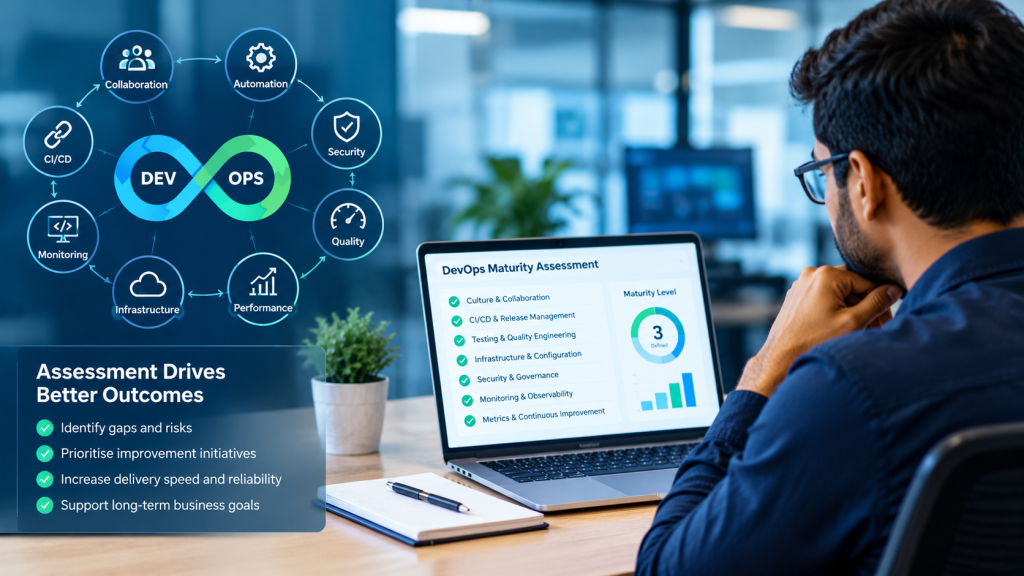
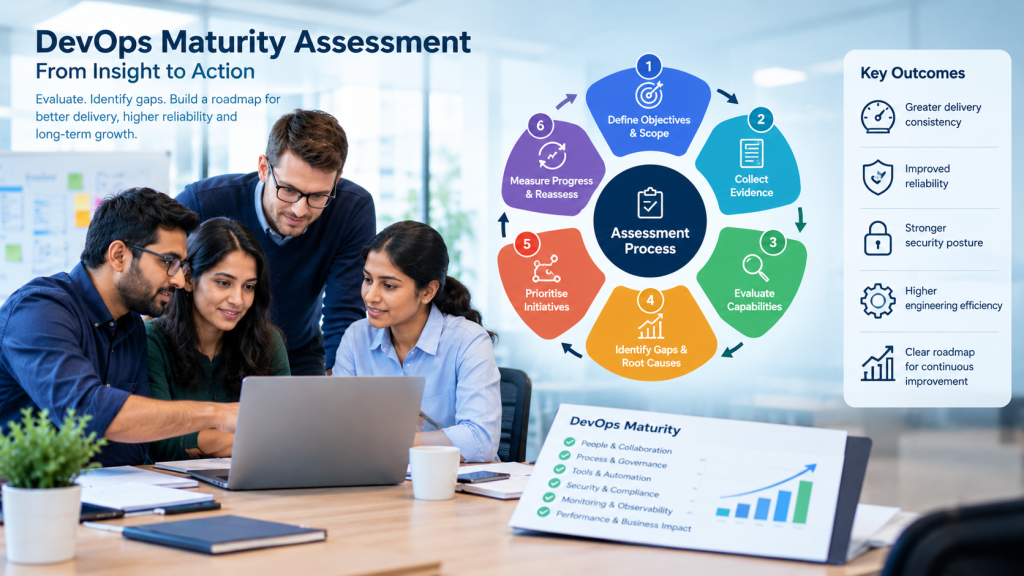
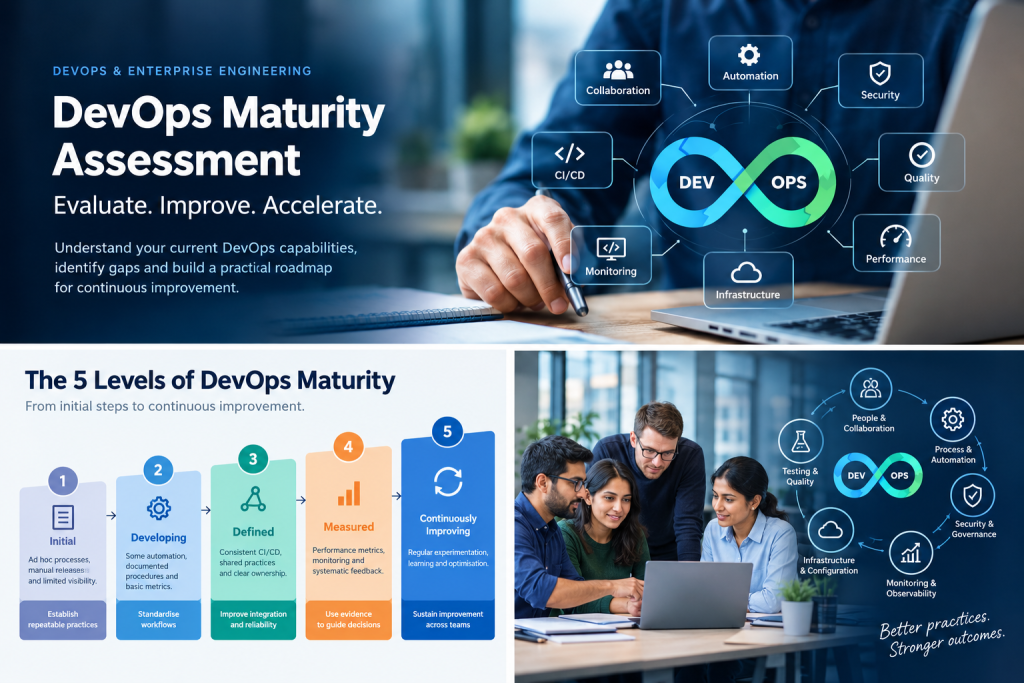
Sandhata applies the DevOps & SRE Maturity Compass to assist financial technology executives in evaluating their current software delivery practices and mapping a clear transformation path.
Level 1: Legacy Sourced Operations. Application deployments rely on manual steps and paper approvals. Mainframe code management remains isolated from modern toolchains, environment configuration drift is common, and audit preparations require manual documentation gathering.
Level 2: Fragmented Automation. Automated build tools compile modern web and mobile applications, but mainframe builds remain manual. Security scanning occurs late in the release cycle, and testing depends on shared, rigid staging environments.
Level 3: Integrated Continuous Compliance. CI/CD pipelines automate deployments across cloud microservices and legacy components. Automated security scanning and Policy as Code checking run during every build, while Service Virtualization replaces manual test environment dependencies.
Level 4: High-Velocity Financial Agility. Enterprise software deployments run continuously through automated compliance gates. Ephemeral testing environments support rapid feature validation, synthetic data generation ensures total data privacy, and self-healing infrastructure delivers maximum system uptime.
The Maturity Compass provides senior financial leaders with clear visibility into technical debt, compliance risks, and actionable steps to achieve modern software delivery.
Section 4: Enterprise Realities – Financial Services Case Studies
Case Study 1: Core Banking Modernization for a Global Retail Bank
A tier-1 global retail bank struggled with slow delivery speeds across its core retail banking engine. Modernizing mobile banking features required tedious manual coordination between cloud application developers and legacy mainframe teams, resulting in software release lead times averaging 16 weeks.
Sandhata deployed a dedicated team of financial DevOps architects to modernize the delivery process. The team established automated Git-based pipelines for COBOL mainframe components, introduced Service Virtualization for core ledger APIs, and embedded automated Policy as Code gates within all deployment channels.
The unified pipeline reduced release lead times by 75%, lowering deployment timelines from 16 weeks to under 3 weeks. System availability reached 99.999%, while automated audit logging saved thousands of engineering hours annually during regulatory reviews.
Case Study 2: Automated Payment Gateway Testing for an International Payments Provider
An international payment processing provider managed high-volume payment routing platforms connecting merchants, credit networks, and banking institutions. Complex manual regression testing caused payment gateway update releases to take over two months, limiting business growth and agility.
Sandhata engineered an enterprise test automation and virtualization solution. Sandhata implemented Service Virtualization to simulate third-party credit card processing networks and built automated, parallel execution pipelines.
Regression testing execution times dropped by 90%, falling from 14 days down to 6 hours. Continuous automated security checks allowed the institution to push weekly performance updates safely while maintaining absolute PCI-DSS compliance.
Section 5: Key Metrics for Financial DevOps Success
Evaluating the success of a DevOps transformation within financial institutions requires monitoring continuous metrics across delivery speed, security, and operational stability:
Deployment Frequency: The number of software releases deployed to production. Financial DevOps increases releases from quarterly batches to weekly or daily updates.
Lead Time for Changes: The total time elapsed from initial code commit to live deployment across banking channels.
Change Failure Rate: The percentage of production releases causing system errors or requiring emergency patches. Advanced automated pipeline validation keeps change failure rates under 1%.
Mean Time to Restore (MTTR): The speed at which core systems recover from unexpected operational outages. Automated deployment infrastructure and self-healing environments dramatically reduce recovery times.
Audit Preparation Time: The total time required to gather evidence for compliance reviews. Automated audit pipelines reduce this from weeks to seconds.
Section 6: Frequently Asked Questions (FAQs)
FAQ 1: What is DevOps for Financial Services?
DevOps for Financial Services is an enterprise engineering practice that automates software delivery across banking systems, investment platforms, and payment networks while embedding strict compliance checks, automated security scanning, and legacy mainframe integration.
FAQ 2: How does Sandhata modernize mainframe development in core banking?
Sandhata connects traditional mainframe application lifecycles with modern Git-based CI/CD pipelines, enabling developers to write, test, and validate COBOL and mainframe code using modern developer toolchains and automated testing frameworks.
FAQ 3: How does DevOps help banks comply with regulatory requirements such as DORA and PRA rules?
DevOps automates compliance by generating tamper-proof, immutable audit records during every code commit, pipeline build, security scan, and deployment, ensuring constant readiness for regulator checks without manual spreadsheet assembly.
FAQ 4: What is the role of Service Virtualization in financial services DevOps?
Service Virtualization simulates complex payment gateways, core ledger databases, and third-party financial APIs, enabling banking development teams to run continuous automated integration tests without relying on live backend services or risking real financial transactions.
FAQ 5: How does automated security work within banking DevOps pipelines?
Security tools perform static code evaluation, dependency vulnerability scanning, container inspection, and dynamic runtime testing continuously inside the build pipeline, blocking vulnerabilities before code ever reaches production systems.
FAQ 6: How can banks safely accelerate release frequencies without causing system downtime?
By shifting to automated testing, Policy as Code governance, zero-downtime deployment patterns, canary releases, and automated rollback capabilities, banks eliminate manual release mistakes and reduce change failure rates to under one percent.
FAQ 7: How does Sandhata handle customer data privacy in lower development environments?
Sandhata enforces strict automated data masking and synthetic test data generation within non-production environments, guaranteeing that developers work with realistic data structures while ensuring sensitive financial and personal data remains protected.
FAQ 8: What is Policy as Code in financial technology compliance?
Policy as Code defines security mandates, encryption rules, and regulatory controls in code format. Continuous delivery pipelines evaluate infrastructure templates and software builds against these rules automatically, preventing non-compliant deployments.
FAQ 9: How does DevOps support Open Banking and API enablement?
DevOps automates the testing, security scanning, and deployment of Open Banking APIs, allowing financial institutions to expose secure services to fintech partners while maintaining strict API rate limits, encryption, and operational resilience.
FAQ 10: Can DevOps be implemented across hybrid legacy and cloud banking platforms?
Yes. Sandhata specializes in hybrid cloud and legacy engineering, building unified orchestration platforms that coordinate deployments simultaneously across public cloud microservices, private clouds, and core legacy mainframes.
FAQ 11: How does Sandhata assess a bank’s current DevOps maturity level?
Sandhata applies the DevOps & SRE Maturity Compass, evaluating the institution across 30 to 40 technical dimensions—including pipeline automation, security integration, legacy connectivity, and governance—to map an actionable modernization journey.
FAQ 12: What are ephemeral environments, and how do they benefit financial technology teams?
Ephemeral environments are temporary testing setups created automatically for specific feature branches. Once testing finishes, the environment is automatically destroyed, saving infrastructure costs and eliminating environment configuration conflicts.
FAQ 13: How does DevOps transform Change Advisory Board processes in banks?
DevOps replaces manual CAB spreadsheets with automated governance gates. When a code commit passes all automated unit, integration, performance, and security checks, compliance approval is granted programmatically based on verifiable evidence.
FAQ 14: What key metrics measure the success of financial services DevOps transformations?
Primary indicators include Deployment Frequency, Change Lead Time, Change Failure Rate, Mean Time to Restore, and Audit Preparation Lead Time.
FAQ 15: How long does a typical banking DevOps modernization engagement take with Sandhata?
Initial discovery audits using the Maturity Compass take 2 to 4 weeks. High-impact automated pipelines, core integration frameworks, and pilot team rollouts deliver measurable results within 8 to 12 weeks.
Strategic Recommendation and Next Steps
Financial institutions operate under a constant imperative to innovate rapidly while preserving security, system uptime, and absolute regulatory compliance. Continuing to rely on manual release processes, manual testing, and disconnected mainframe operations increases business risk, inflates operational costs, and delays software delivery.
DevOps for Financial Services offers a practical, enterprise-grade model for digital transformation. By automating pipeline governance, integrating legacy mainframes, embedding DevSecOps controls, and virtualizing third-party dependencies, banks can deliver software continuously with complete confidence.
Sandhata Technologies brings over two decades of experience modernizing complex enterprise systems for leading global banks and financial institutions.
Contact Sandhata’s Financial Services Engineering Team today to request your DevOps & SRE Maturity Compass Assessment and build your modern banking delivery engine.